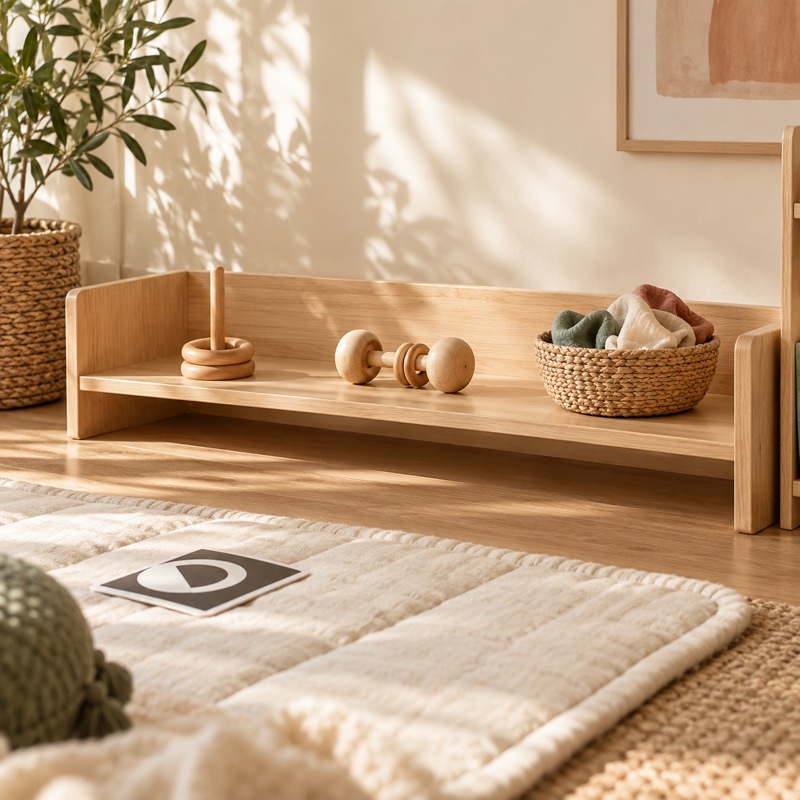
When most people hear “Montessori,” they picture a set of beautiful, expensive wooden toys. That is the marketing, not the method. Reading The Montessori Baby by Simone Davies and Junnifa Uzodike this pregnancy, what struck me is how little of it is about the objects at all. Montessori is a way of seeing the first two years: what a baby is actually doing when it looks like they are doing nothing, and how to get out of their way. That is the part worth caring about, and it is mostly free.
Here is why I keep coming back to it as I set up our home for this summer.
It starts at birth, not preschool
The biggest misconception is that Montessori is a preschool thing. Maria Montessori built her whole method around the opposite idea: that the earliest years, the ones we most underestimate, are when the deepest work happens. The brain triples in volume in the first year. The visual system is barely developed at birth. Attachment, spatial reasoning, and the scaffolding of language are all being laid down long before a baby looks like they are learning anything.
That is exactly the window everyone waves off as “they just eat and sleep.” Montessori treats it as the main event. Once I read it that way, I could not un-see it.
The prepared environment
The core idea, the one everything else hangs on, is the prepared environment. Not a themed nursery. A space quietly arranged so the baby can do as much as possible for himself, safely, without being managed every second.
For a newborn that is almost nothing, and that is the point:
- A firm floor mat instead of a container. Bouncers and swings hold a baby still. A firm surface lets him move against something and build strength. The same reason tummy time works on the floor and not on a squishy pillow.
- A low mirror at his level, so he can study faces, including his own, and follow movement.
- A few real objects within reach, rotated rather than piled up. A wooden rattle, a natural teether, one high-contrast image. Less on the shelf means more attention on each thing.
- Freedom of movement. No shoes, loose clothes, room to kick and reach and, later, to roll and crawl toward what interests him.
I wrote more about the specific pieces in our toy list, and the short version is that the environment matters far more than any single item in it.
”Never do for a child what he can do for himself”
“Never do for a child what he can do for himself.”
Maria Montessori
This line is the whole philosophy in eight words, and it is harder to live than it sounds. It is faster to spoon the food in myself. It is faster to do the buttons. Montessori asks me to slow down and let him try, because the trying is the development.
In practice that looks small at first. Putting the spoon in his hand instead of his mouth, even when it is messier. Pausing before I rush in to fix the tower that fell. Letting him work at the puzzle piece a beat longer than is comfortable for me. The method calls it following the child: watching what he is drawn to and supporting that, rather than steering him through my agenda. Independence is not something you hand a toddler at two. It is something you protect from the very beginning.
Concentration, order, and real things
Two more Montessori ideas have quietly changed how I am setting things up.
The first is concentration. When a baby is deeply focused on something, even just a hand in a sunbeam, the instinct is to jump in and narrate or praise. Montessori says protect that focus instead. Uninterrupted attention is a skill, and it is being built in those quiet minutes.
The second is real things over pretend ones. A small real cup instead of a sippy that never spills. A natural material he can actually feel the weight of. Order in the space, so the same things live in the same places. Babies find deep security in order and in the real, and that settledness is not separate from learning. A regulated baby is a baby who is free to explore.
What the research backs up
I am wary of anything that promises to optimize a baby, so I went looking for where the evidence actually lands. It holds up in the places that matter most:
- Freedom of movement supports motor development. Babies given floor time and room to move hit motor milestones on a healthy track, without props pushing them there early.
- Narration and rich language exposure is one of the most reliable predictors of later language. Talking through the day is doing real work.
- Responsive, secure attachment is the foundation the rest is built on, and it lines up with what Hunt, Gather, Parent by Michaeleen Doucleff reports from cultures that raise capable, helpful kids by bringing them into real life early.
I want to be honest about the ceiling here, though. Montessori is not magic, and it is not a competition. It is a calm, respectful default, not a guarantee. Every baby develops at their own pace, and any real concern belongs with your pediatrician, not a parenting philosophy.
How we’re actually doing it
None of this required the expensive version. Our setup is a firm mat on the floor, a low mirror, a small basket of a few real-material toys we swap weekly, and a lot of talking. The rest is restraint: fewer things out, more room to move, and me sitting back a little longer before I step in.
That is the quiet promise of Montessori in the first two years. Not a shelf of perfect toys, but a prepared space, a respected baby, and a parent willing to do a little less so their child can do a little more.
If you want the stage-by-stage version, I have organized the whole thing from newborn to two. Download the free app to see it.