If you’re pregnant and scrolling through someone else’s Montessori toy list at 11pm, this one is for you. I’ve spent the last few months adding things to carts and then deleting them. Reading product descriptions, then reading the actual research behind them. We’re a few weeks out from meeting our July baby, and the nursery is completed. What I want to tell you is this: almost everything on every list you’ll read is a suggestion.
Here’s what we’ve bought, what we skipped, and where a homemade version does the same thing as the store-bought one.
On mobiles: lovely, but optional
The Munari mobile is the Montessori classic for the first six weeks. High-contrast black and white geometric shapes, hung above a non-mobile baby, designed for newborn vision that can only really see strong contrast in those early days. The science behind it is solid. The $40 price tag for a piece of cardstock on a string is not required to participate.
You can make a Munari in an afternoon with black cardstock, white string, and a wooden dowel from a craft store. Or skip the dowel entirely and tape a black-and-white image to the ceiling above the changing table, around eight to twelve inches from baby’s eyes. The visual contrast does the developmental work. The wood frame doesn’t.
We skipped the Munari entirely. Instead, we have high-contrast board books we can dangle above him or prop open wherever he happens to be. Same visual contrast, nothing extra to buy, and the books keep earning their keep once he starts reaching for the pages.
On the Pikler: a floor mirror goes further
A Pikler triangle is a wooden climbing frame. Beautiful, expensive, and not useful for the first half of the first year. Babies don’t climb at three months. What they need at that age is to see themselves.
We have a small floor mirror set up at his level from day one. By around three months we plan to swap it for a bigger one he can really see himself in. From the day baby comes home, a low mirror does most of what a Pikler eventually will: visual exploration, self-recognition during tummy time, a focal point on a quiet morning.
When the climbing window opens, somewhere around nine or ten months, you still don’t have to buy a Pikler. A low couch cushion. A pile of board books to scramble over. The bottom step of the staircase with a hand close by. By eighteen months, the climbing that matters most is outside: a low tree branch, a playground, the back of a soft hill.
On Lovevery: it’s a guide, sold in a box
I love what Lovevery does. Their kits are well-researched, age-paced, and beautifully made. They’ve also published their stage guides openly on their blog, which means you can read what should be in front of your baby at each age and source the pieces yourself.
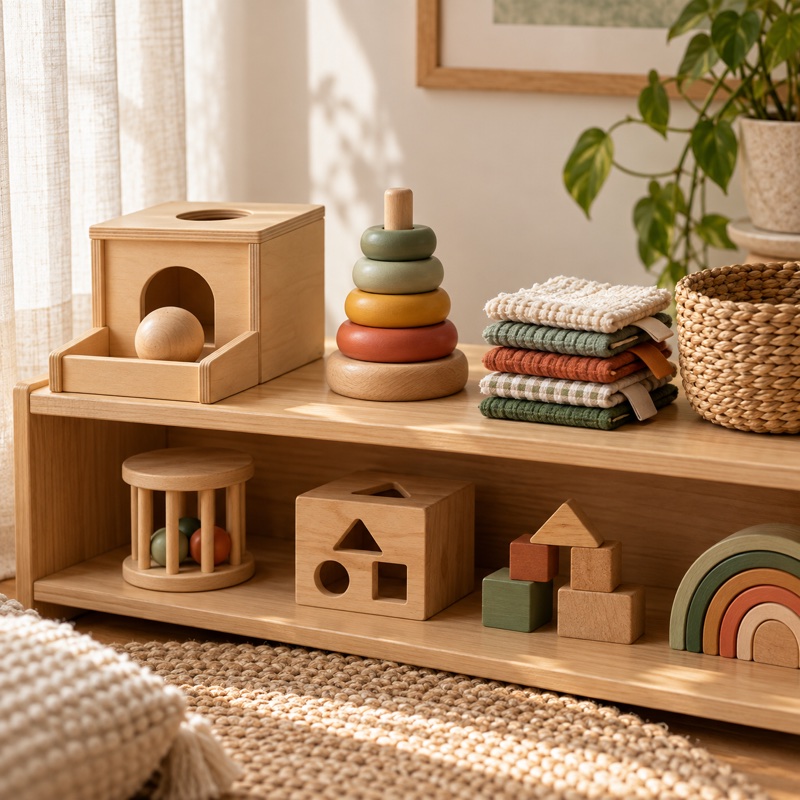
An object permanence box from a small Etsy shop is about $12. The Lovevery version ships inside The Charmer kit at $80. The wooden balls, the stacker, the spinning drum, all of these are sold individually on Amazon and other sites for a fraction of the kit price.
The kits are still a fine choice if you’d rather pay for the curation than do the homework. I’m not against them. I just want you to know you have a choice between paying for the research and reading it yourself.
What’s actually on our shelf
Stripped down to what I keep coming back to:
- One floor mirror. Small to start, a larger one by three months.
- A simple basket of natural-material teethers. Three or four pieces, swapped weekly.
- A couple of rattles in different materials. Wood, soft cloth, lightweight plastic. Each one gives him something different to feel, hear, and figure out.
- Hanging toys we swap by stage. High-contrast for the first weeks, soft color around six weeks, then ones he can bat at and grab as he grows. The same hook above his play space carries each one.
- A thick, cushioned play mat and a soft cotton blanket for tummy time on the wood floor.
- Real books. Hunny My Bunny, The Very Hungry Caterpillar, board-book editions. Not toys, exactly, but the most-used thing in the house.
The rest of the list lives in the full development guide. I have researched and organized it by age group, from the first weeks all the way through two years, so you know what to reach for at each stage and what can wait. Download the free app to see the whole thing.
A toy list is a starting point. Your home, your budget, your baby’s pace get the last word.